
Abstract
Public safety netting in construction, sports, and infrastructure is moving into a new phase of development. What was once designed primarily through experience, standard practice, and generalized safety rules is now increasingly shaped by data analytics, simulation, and site-specific engineering.
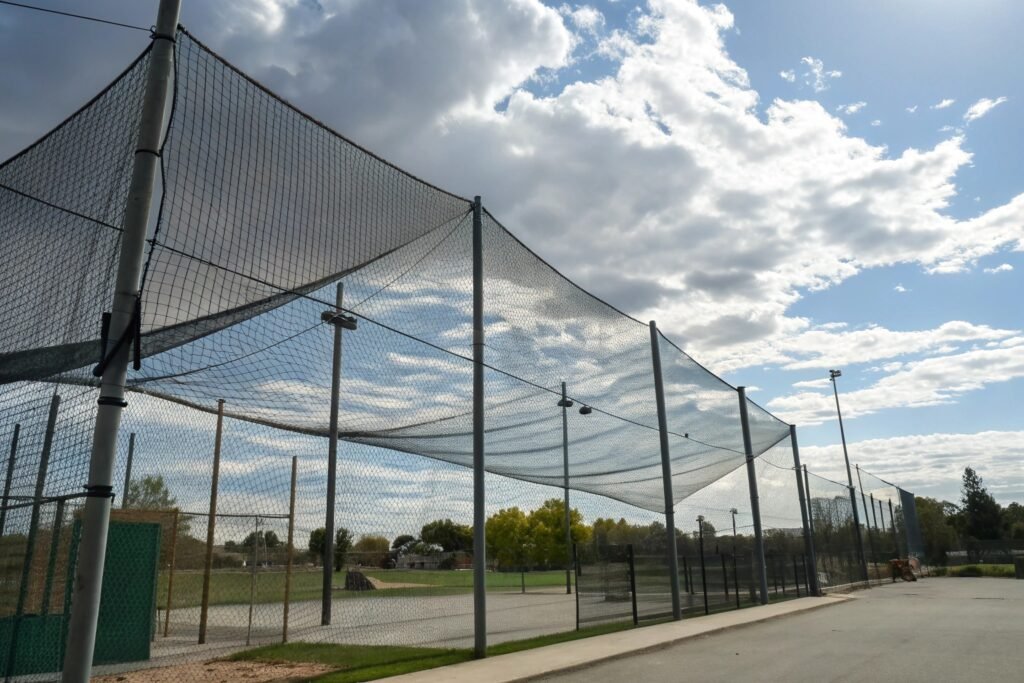
Today, the placement and design of public safety netting can be informed by predictive modeling, historical incident mapping, real-time sensor feedback, material degradation analysis, Computational Fluid Dynamics (CFD), biomechanical modeling, and geospatial intelligence. This shift allows engineers to design protective netting systems that respond to the real risk profile of a site rather than relying only on broad assumptions or minimum code-based decisions.
The result is a more accurate, more reliable, and more proactive approach to safety. Instead of treating netting as a passive barrier, modern engineering increasingly treats it as a performance-driven safety system designed to reduce injury risk, improve durability, and support better long-term asset management.
Key Takeaways
- Use historical incident data to identify high-risk zones for netting placement.
- Select materials based on quantified environmental degradation data, not just generic specifications.
- Apply wind load simulations to optimize net porosity, anchor point design, and structural performance.
- Use biomechanical modeling to improve energy absorption and reduce injury severity in fall arrest applications.
- Integrate GIS and other geospatial data for site-specific safety netting design.
- Shift from reactive safety planning to predictive, data-driven engineering.
- Work with manufacturers that can support application-specific, engineered netting solutions.
A Paradigm Shift: From Intuition to Information
For many years, the placement of construction safety netting, sports barrier netting, and other public protection systems was guided by a mix of code requirements, field experience, and practical judgment. This approach often worked, but it was limited by the scope of individual knowledge and by the inability to account for all the site-specific factors that influence risk.
A skilled supervisor could look at a building facade, a stadium perimeter, or a bridge span and make a reasonable judgment about where protection should be installed. But reasonable judgment is not the same as measurable optimization. It does not fully capture localized wind behavior, cumulative UV exposure, repeated stress at specific anchor points, or recurring incident patterns that only become visible when large datasets are analyzed together.

That is where modern data-driven design changes the conversation. Instead of asking only where netting is typically placed, engineers can now ask where it is statistically most needed, how it will behave under actual site conditions, and how its performance will change over time.
This marks a major shift in safety philosophy. Public safety is no longer treated only as a compliance checklist. It is increasingly treated as a dynamic engineering problem that can be modeled, tested, monitored, and continuously improved.
Traditional vs. Data-Driven Netting Design Approaches
| Feature | Traditional Approach | Data-Driven Approach |
|---|---|---|
| Placement Basis | Experience, regulations, visual inspection | Predictive analytics, incident mapping, real-time monitoring |
| Material Selection | Standard grades and general durability ratings | Material degradation data, environmental performance, site-specific requirements |
| Design Process | Standard dimensions and manual calculations | CFD, FEA, digital modeling, and algorithm-based optimization |
| Wind Load Analysis | Rule-of-thumb estimates and simplified tables | Microclimate modeling, pressure mapping, and site-specific airflow analysis |
| Impact Analysis | Basic drop tests and simple force estimates | Biomechanical simulations, injury modeling, and dynamic performance analysis |
| Maintenance | Scheduled visual inspections | Predictive maintenance based on sensor data and degradation trends |
| Customization | Limited to basic sizing and color options | Highly site-specific customization of mesh size, material, porosity, and tension |
This comparison does not suggest that field experience is no longer valuable. On the contrary, experience remains essential. The difference is that experience can now be validated, refined, and extended through data.
Data Sources That Influence Netting Design
| Data Source | Type of Data | Application in Netting Design |
|---|---|---|
| Historical Safety Records | Accident reports, near-miss logs, incident trends | Identifying recurring hazard zones and guiding proactive placement strategies |
| On-Site Sensors | Wind speed, vibration, tension, UV exposure | Real-time monitoring, risk alerts, and predictive maintenance |
| Material Science Databases | Tensile strength, chemical resistance, UV performance, fatigue data | Selecting the right polymer or fiber for site-specific conditions |
| Weather and Climate Data | Wind patterns, rainfall, temperature extremes, environmental exposure | Long-term durability planning and structural design under local conditions |
| Biomechanical Models | Human impact tolerance, force distribution, injury thresholds | Optimizing fall arrest netting for lower injury risk |
| Geospatial Data (GIS) | 3D site geometry, terrain, urban layout, environmental mapping | Site-specific placement and customized safety planning |
| Engineering Simulations | CFD and structural analysis outputs | Testing net performance under real-world wind and load conditions before installation |
construction safety netting guide and protective netting design.
Predictive Modeling for Proactive Hazard Mitigation
Traditional safety planning often responds to incidents after patterns have already emerged. Predictive modeling changes that logic. Instead of reacting to known failures, it identifies where risk is most likely to develop before an incident occurs.
Analyzing Historical Incident Data
Modern predictive modeling begins with data aggregation. Safety teams can now analyze information from accident databases, internal safety reports, near-miss logs, and public regulatory records to uncover risk patterns that are difficult to detect through manual review alone.
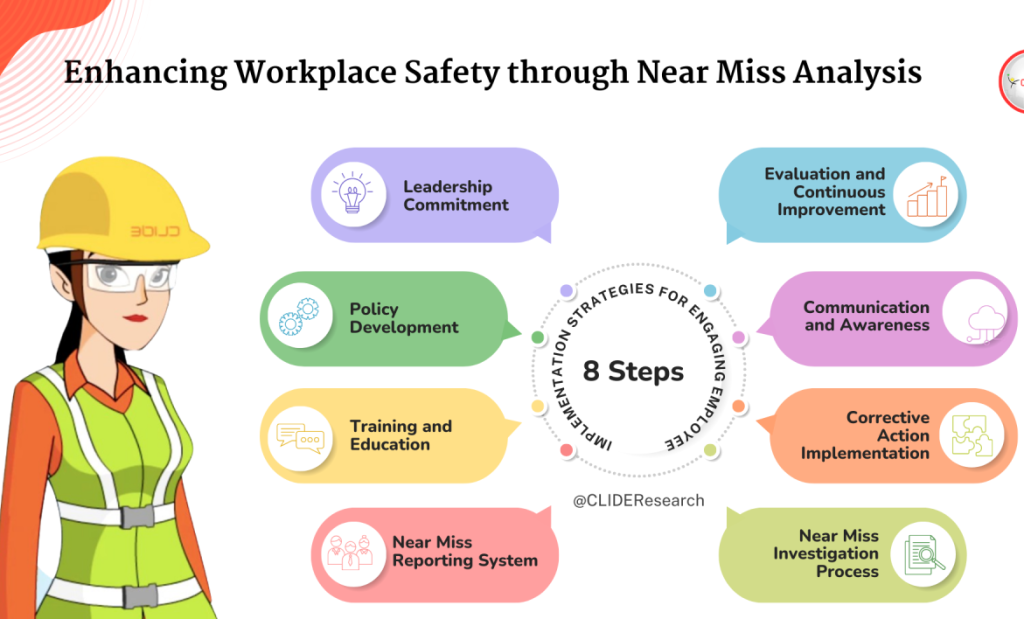
When this data is analyzed at scale, it often reveals useful correlations. Falling-object incidents may cluster at certain elevations, during particular construction activities, or on specific building facades exposed to prevailing wind conditions. Once those patterns are identified, debris netting systems can be placed and specified with much greater precision.
Turning Data Into Actionable Risk Profiles
Instead of applying uniform perimeter protection, project teams can use predictive models to strengthen protection only where it is most needed. That may mean increasing mesh density in a high-risk zone, upgrading the impact rating for a particular facade, or adjusting installation timing to align with specific high-risk work phases.
This leads to a better use of safety resources. More importantly, it leads to better protection.
Using Sensor Data for Real-Time Risk Assessment
Historical data provides a baseline. Real-time sensors provide live operating intelligence. Modern netting systems can be equipped with anemometers, strain gauges, accelerometers, and UV sensors to monitor how the system performs in actual field conditions.
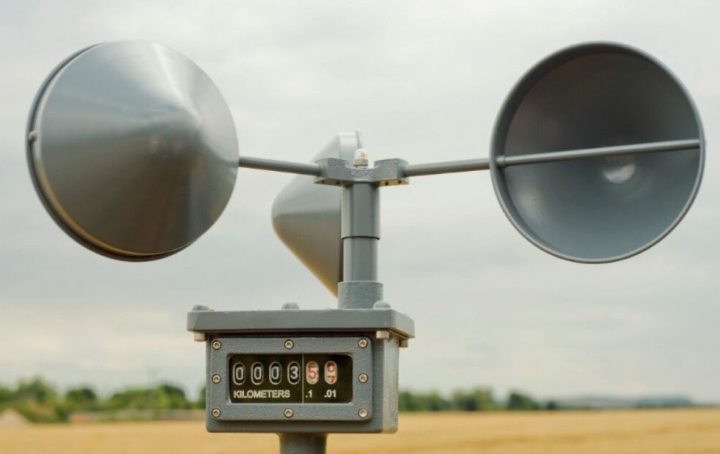
These sensors can detect wind changes, tension imbalance, impact events, and cumulative exposure that may affect long-term performance. Instead of waiting for scheduled inspections to reveal problems, site teams can respond to early warnings and intervene before failure occurs.
Digital Twin and Continuous Monitoring
Sensor data becomes even more valuable when connected to a digital twin of the installation. A digital twin is a virtual model that reflects the real-world condition of the physical netting system. If loads increase abnormally at one anchor point, or if a section experiences repeated impacts, the digital model can flag that zone for immediate attention.
This changes the role of netting. It is no longer only a passive safety barrier. It becomes an active, monitored component of the broader safety system.
Simulating “What-If” Scenarios Before Installation
Predictive modeling also allows engineers to test scenarios that would be dangerous or impractical to evaluate physically. Using digital models, designers can simulate falling-object trajectories, wind-driven lateral drift, impact angles, and the effectiveness of different net positions and extension lengths.
For example, simulation may show that a cantilevered net extending 10 feet is not enough under certain wind conditions, while a 15-foot extension provides the required capture probability. It may also show that certain object types are more likely to ricochet off a facade before hitting the net, requiring a design change before installation begins.
These are not theoretical improvements. They are practical design decisions grounded in quantified risk analysis.
For related content, check our article here:
Advanced Material Science Through a Data-Centric Lens
The long-term effectiveness of any public safety netting system depends on material performance. Traditionally, materials were chosen from broad categories such as HDPE, nylon, or polypropylene using general strength and durability specifications. A data-driven approach is much more precise.
Data-Driven Selection of Polymers and Fibers
Material selection now begins with site conditions. Engineers first evaluate UV exposure, temperature swings, humidity, airborne chemicals, salt content, and expected mechanical stress. That information is then matched against material databases containing tensile retention curves, UV resistance data, abrasion performance, and chemical compatibility profiles.
This changes the decision-making process. Instead of asking which material is generally better, engineers ask which material will maintain required performance under the exact environmental and operational conditions of the project.
Wear-and-Tear Analysis Through Sensor Feedback
Material behavior does not stop mattering after installation. Netting experiences creep, stress cycling, environmental aging, and repeated impact. Strain gauges and other embedded sensors can reveal changes in elongation, tension distribution, and long-term deformation.
That data supports predictive maintenance. Instead of replacing netting only because a calendar says it is time, teams can replace it based on actual condition and performance trends. This reduces both risk and unnecessary cost.
Environmental Degradation Modeling
UV radiation remains one of the most common causes of polymer degradation in outdoor netting. Moisture, chemicals, pollution, and salt exposure can also reduce long-term performance. Accelerated weathering tests allow manufacturers to build degradation curves that show how material strength declines over time under specific conditions.
When these degradation curves are combined with local climate data, engineers can estimate service life much more accurately. A standard product might be acceptable for a short-term application, while a UV-stabilized or chemically resistant material may be necessary for a long-term installation in a harsh environment.
This is especially important for custom netting solutions in coastal infrastructure, mountain projects, industrial zones, and permanent sports facilities.
Computational Fluid Dynamics (CFD) in Netting Design
Wind is one of the most important and most underestimated forces acting on large netting systems. In high-rise construction and large-scale infrastructure, an improperly designed net can act like a sail, generating loads that threaten the integrity of both the net and its anchorage system.
The Problem of Non-Uniform Wind Behavior
Wind does not move uniformly around buildings, bridges, and stadium structures. It accelerates around corners, creates low-pressure turbulence on leeward sides, and forms updrafts and downdrafts in dense urban environments. Simplified wind tables cannot fully capture these effects.
How CFD Improves Netting Design
Computational Fluid Dynamics (CFD) provides a more accurate alternative. Using a detailed 3D model of the site and surrounding environment, CFD simulates airflow and pressure distribution across the structure and the proposed netting system.
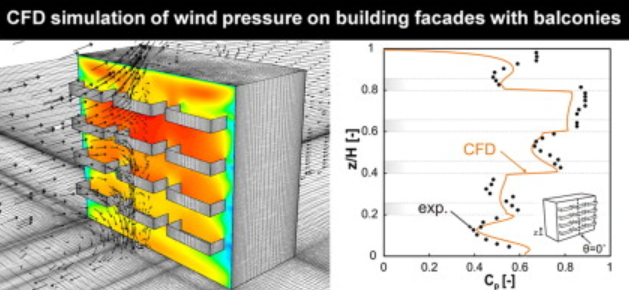
This allows engineers to visualize where pressure is highest, where turbulence may create unpredictable loads, and how airflow interacts with different mesh densities and structural layouts.
Optimizing Porosity, Anchorage, and Deformation
CFD helps engineers refine several critical design variables:
- Mesh porosity: balancing object containment with reduced wind load
- Anchor point placement: reinforcing high-load zones and avoiding unnecessary over-design elsewhere
- System deformation: evaluating stretch, sag, and structural interaction under wind pressure
When CFD is combined with structural modeling such as Finite Element Analysis (FEA), the result is a much more reliable understanding of how the netting system will perform under real operating conditions.
That means safer designs, more efficient material use, and stronger long-term system performance.
Biomechanical Modeling for Human-Centered Safety
Debris netting is designed to stop objects. Fall arrest netting is designed to protect human life. These are not the same engineering problem.
Understanding Human Fall Dynamics
A falling human body is not rigid, and it does not strike a net in a predictable single orientation. People can fall feet-first, back-first, sideways, or in twisting motion. Different parts of the body also have very different tolerances for impact.
That is why the design of fall arrest safety netting must consider not just whether the net can hold the load, but how it absorbs energy and distributes force during impact.
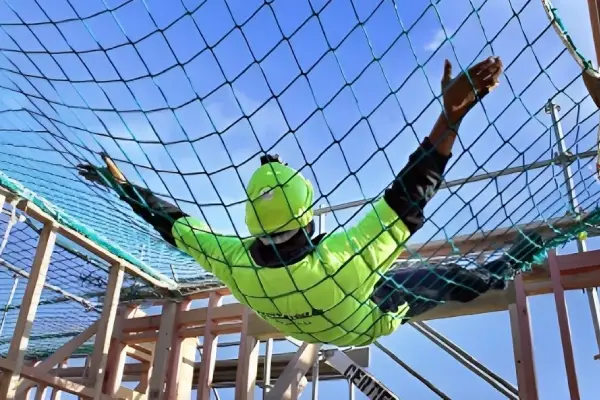
Using Biomechanical Models in Netting Design
Modern biomechanical modeling draws on crash testing data, injury thresholds, digital human body models, and validated simulation methods to predict how a person will interact with a safety net during a fall.
These simulations evaluate:
- Deceleration forces experienced by the body
- How impact forces are distributed across different body regions
- How much the net sags during energy absorption
- Whether rebound or entanglement risk is likely
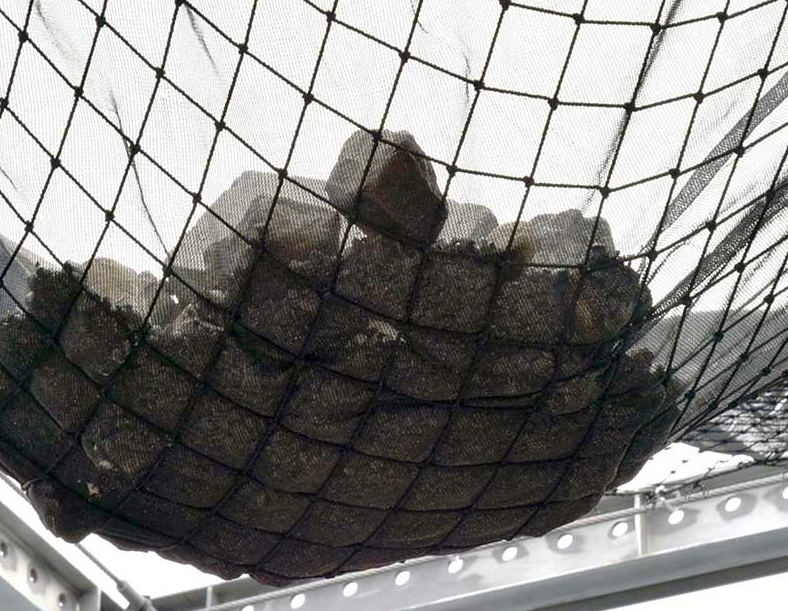
Designing for Safer Energy Dissipation
The purpose of the net is not simply to stop the fall. It is to do so in a way that reduces injury severity. This requires careful tuning of several variables:
- Net tension: too tight increases impact force; too loose increases excessive sag
- Mesh geometry: influences body support and load distribution
- Material elasticity: affects the deceleration curve and overall energy absorption
This is a major step beyond traditional strength-based thinking. The relevant question is no longer only whether the net breaks. The relevant question is whether it protects the person safely.
Geospatial Data for Site-Specific Netting Design
No two sites present exactly the same hazard profile. A mountain bridge, an urban high-rise, and a sports stadium all operate under very different environmental and operational conditions. Geospatial Information Systems (GIS) help engineers understand those differences and translate them into site-specific design decisions.
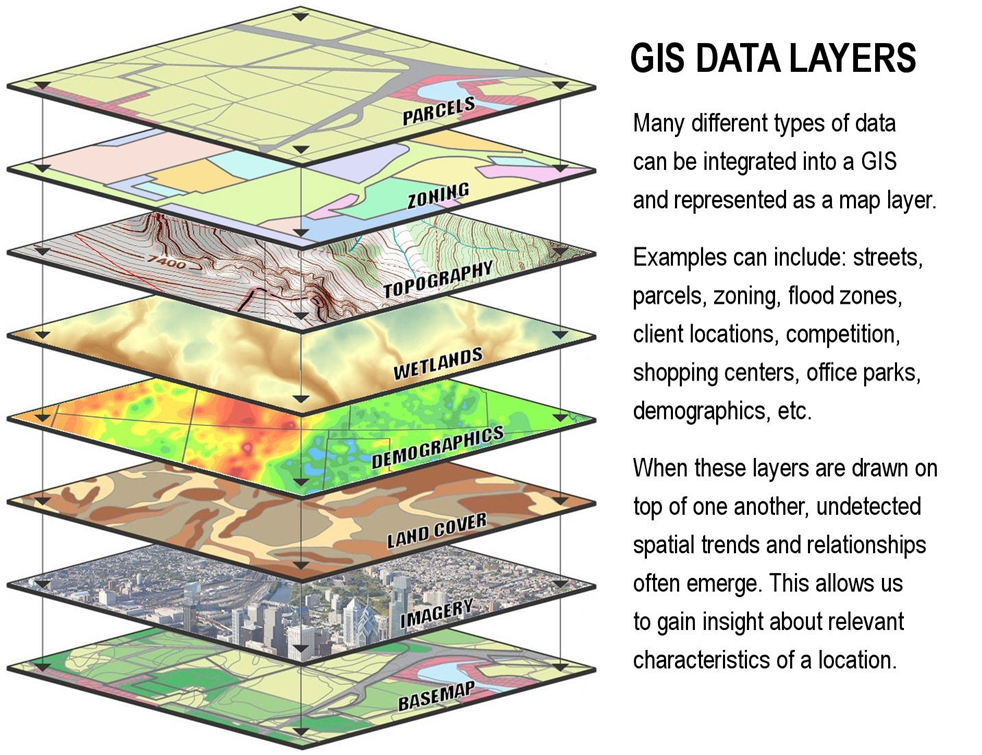
Leveraging GIS for Large-Scale Projects
GIS allows teams to layer multiple forms of spatial data into one planning model. That may include 3D structural geometry, terrain, elevation, pedestrian traffic, surrounding building massing, weather patterns, and environmental exposure mapping.
This is especially valuable on large infrastructure projects where the risk profile changes significantly across the site.
From Location Data to Risk Intelligence
By combining geospatial data with environmental and safety analysis, engineers can identify where falling-object risk is highest, where wind patterns increase exposure, and where public or operational vulnerability is greatest.
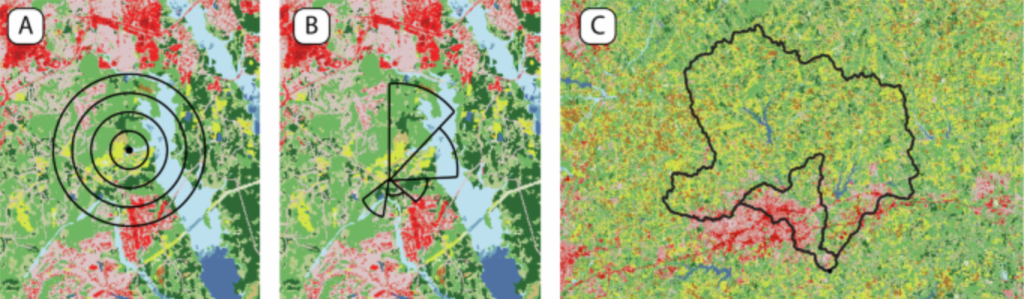
That makes it possible to place netting where it delivers the most meaningful safety impact rather than simply applying a uniform layout everywhere.
Bridge vs. Urban High-Rise: A Practical Comparison
A bridge in a coastal mountain environment may require high-porosity netting, corrosion-resistant anchors, and materials selected specifically for salt and UV exposure. An urban skyscraper may require cantilevered debris netting positioned to protect pedestrian areas affected by lateral wind-driven trajectories rather than just the ground directly below the facade.
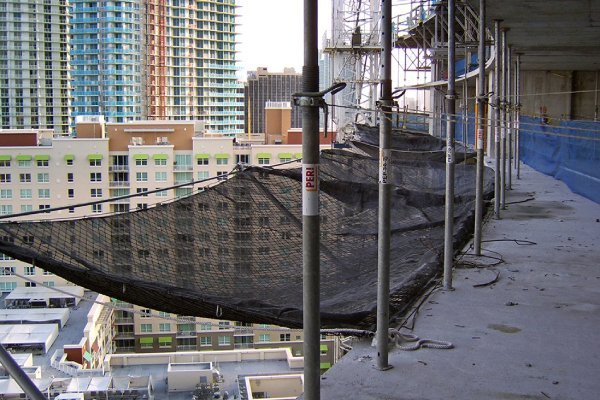
In both cases, the function is similar, but the design solution is entirely different. That is exactly why geospatial context matters.
custom netting solutions and sports barrier netting.
Frequently Asked Questions
1. What is the biggest advantage of data-driven netting design?
The biggest advantage is the shift from reactive safety to predictive safety. Instead of responding to incidents after they occur, teams can identify likely risk zones in advance and design more targeted, effective protection.
2. Does data-driven netting design increase cost?
Initial engineering and analysis may increase upfront cost, but the long-term benefits are often significant. Better material selection, optimized structural design, reduced accident risk, and predictive maintenance can lower total lifecycle cost.
3. Is this approach legally required?
Not always in explicit form, but data-driven methods are increasingly aligned with best-practice expectations. In high-risk projects, they can also strengthen a company’s safety and liability position.
4. Can smaller projects benefit from these methods?
Yes. Even without advanced simulation, smaller projects can still use local weather data, historical incident information, and manufacturer performance data to make better specification decisions.
5. What data matters most for sports netting?
Projectile speed, mass, trajectory, and long-term environmental exposure are all important. These factors influence net height, placement, mesh size, and material selection for sports safety netting.
6. How do sensors improve netting safety?
Sensors provide real-time information about load, tension, impact, and environmental exposure. This supports faster intervention and more accurate maintenance planning.
7. Does data replace physical inspection?
No. It improves inspection by showing where attention is needed most. Physical inspection remains essential, but data makes it more efficient and better targeted.
Conclusion
The use of data in public safety netting design represents a fundamental change in how protective systems are specified, evaluated, and managed. Safety engineering is moving away from approximation and toward precision. It is moving away from static assumptions and toward responsive, evidence-based decision-making.
By combining historical safety records, sensor data, material performance modeling, CFD, biomechanical simulation, and geospatial intelligence, engineers can now create engineered netting systems that are more reliable, more durable, and more effective in real-world conditions.
For contractors, infrastructure owners, sports facility managers, and procurement teams, the takeaway is clear: public safety netting should not be treated as a commodity product. It should be selected and designed as a critical safety system with measurable performance requirements and site-specific engineering logic.
Organizations that adopt this mindset will be in a stronger position to improve safety outcomes, reduce long-term risk, extend service life, and support better project execution.

Read our most popular articles.
👉 Download our free product categories
👉 A 15-Point Practical Guide: The Complete Checklist for Sports Netting Installation
👉 Beyond Breaking Strength: A Comprehensive Guide to Netting ion, Safety, and Risk Management
👉 5 Reasons Why Durable, Long-Lasting Products are the New Definition of “Cost-Effective”
👉 The True Cost of Cheap Netting: A Total Cost of Ownership Analysis
👉 UV Stabilizers in Sports Netting: A Comprehensive Guide to Longevity